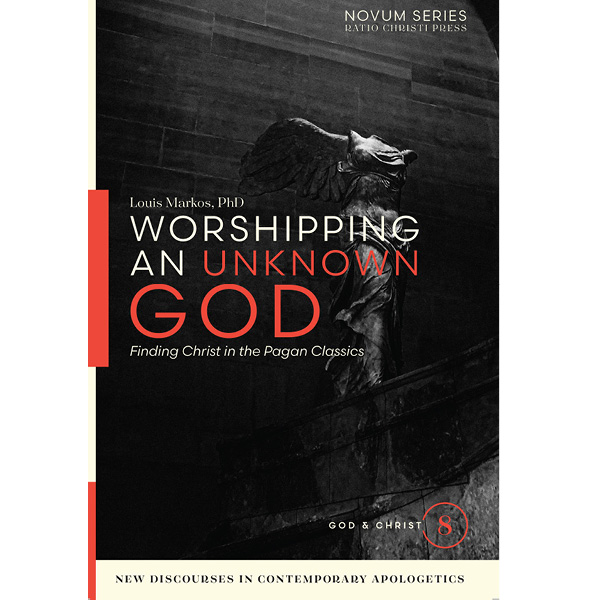
Worshipping An Unknown God
Free Download (Optional Donation)
Finding Christ in the Pagan Classics
Louis Markos, PhD
Access this free e-book and, if you find it valuable, consider supporting the mission with a donation.
Was the story of Jesus borrowed From Pagan Myths? This is a popular claim made by skeptics due the dying and rising gods of ancient Near East myths such as Horus, Osiris, and Mithras.
But what Markos shows is the truth is actually flipped around, that the Christian gospel is the “truth myth” or as C.S. Lewis put it: “The heart of Christianity is a myth which is also a fact.” From Tammuz and Inanna of Babylon to Heracles and Persephone of Greece, Markos shows how the characters, themes and symbols within these myths both foreshadow and find their fulfillment in the story of Jesus Christ.
Markos’ apologetic approach is critical to understanding how the seed of the gospel already resides within today’s secular culture and yesterday’s pagan culture, paving the way for the proclamation of the gospel—the “myth made fact.”
When I use the word “pagan” in this essay, I will not be referring to people who live a licentious lifestyle, nor to “heathens” at enmity with God. Instead, I will be referring to the pre-Christian Greek and Roman writers whom, I will argue, God used to prepare the Greco-Roman world for the coming of Christ. These pagan writers include epic poets Homer, Hesiod, Virgil, and Ovid, lyric poets Epimenides, Pindar, and Horace, historians Herodotus, Thucydides, Livy, and Plutarch, dramatists Aeschylus, Sophocles, Euripides, Aristophanes, and Menander, and philosophers Socrates, Plato, Aristotle, Cicero, Seneca, Epictetus, and Marcus Aurelius.
Although I believe the God of the Bible used pre-Christian writers in Egypt, China, India, Denmark, Australia, Mexico, Peru, and every other country to prepare the way for the gospel, in this book, I will limit myself to how God used pre-Christians writers in Greece and Rome.